 BBC
BBCRobots could help farmers more quickly assess the health of soil, scientists hope as a technology trial takes place in Cornwall.
A gamma ray detector on a device developed by a Cornish company is being used to assess soil quality.
Farmer Malcolm Barrett, a tenant farmer from St Tudy near Bodmin, is working with scientists from the University of Plymouth, who are using a gamma ray detector mounted on a robot to map the health of the soil in his fields.
He said he hoped the technology, which was better and faster than conventional analysis, could make farms more profitable.
 Soil Association
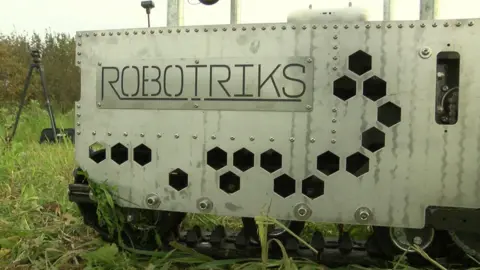
Jake Shaw-Sutton, co-director of robotics company Robotriks in Par, said: “Our newest trial is looking at and focusing on what’s going on with the soil, because it’s often not considered fully and that affects everything around it.”
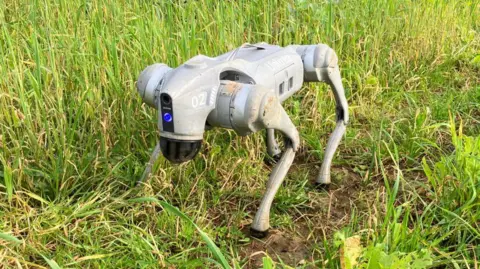
Robot dogs could also be used to examine hard-to-reach places such as hills and hedgerows, he added.
Mr Shaw-Sutton said about the robot dog: “He’s got a top speed of 5m [16ft] a second – which is a tad faster than I am – and he weighs about 15kg [33lb].
“The key advantage is because of those legs he’s able to climb up really difficult terrain and really difficult surfaces.”
The £25,000 gamma detector measures naturally occurring levels of radiation in the soil.
Mr Barrett said: “Usually I’d use a trowel to dig out soil from five areas in a field.
“Then I’d have to send this to a laboratory and wait for the results.”
Will Blake, from the University of Plymouth, said: “The ultimate goal is to provide a map of soil properties that are relevant to the farmer and his decision-making.
“The problem that you have with traditional conventional soil assessments is that they’re very time-consuming and expensive.
“Normally, a farmer can only afford to have a few samples taken from any one field, then you have to wait some days or weeks for the data to come through.”